
Success in
German-American
business is a choice!
Most German-American ventures underperform, and too many fail outright, but some succeed beyond anyone’s most optimistic expectations.
What’s the difference? Informed cultural alignment. Learn it here
WHY THIS TRAINING EXISTS
When cultures collide,
performance suffers.
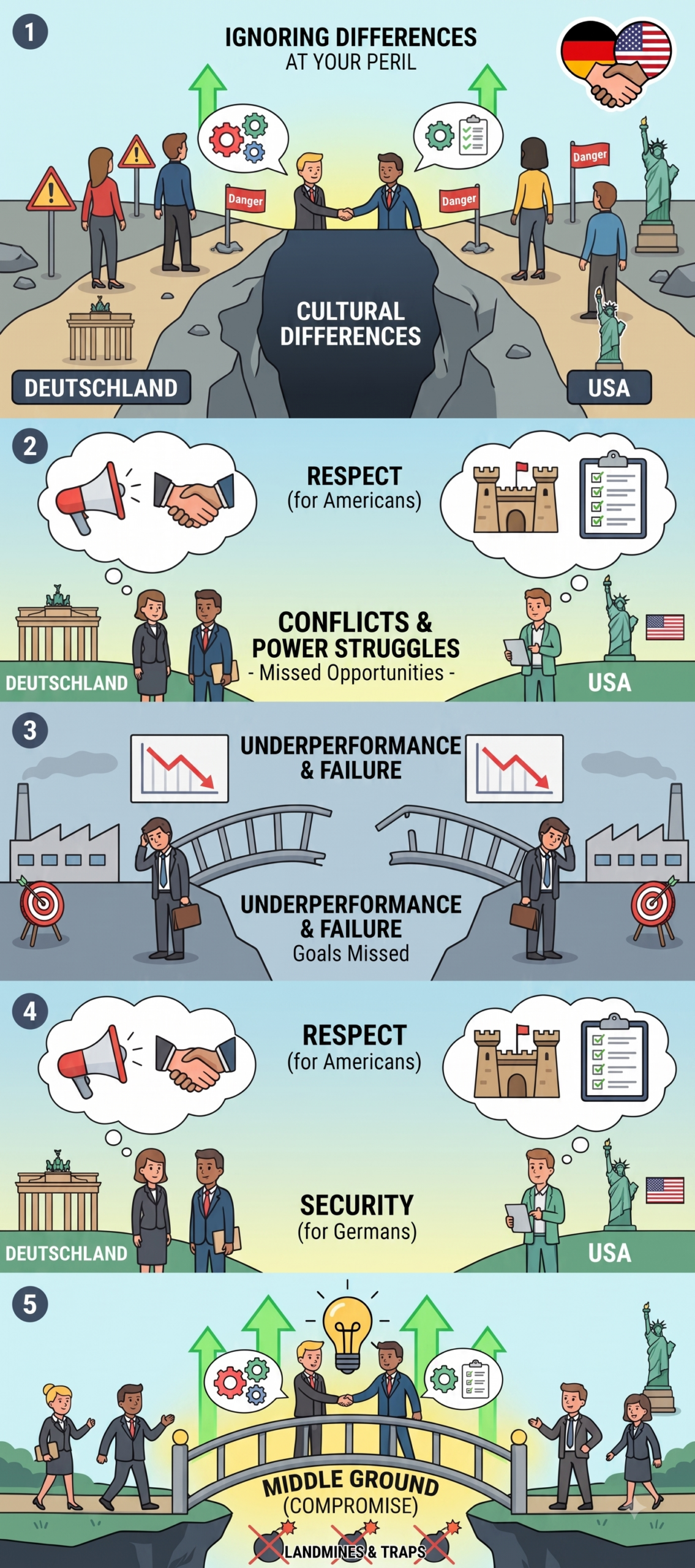
Germany and the USA have significantly different business cultures. However, both Germans and Americans tend to ignore these differences at their peril.
Although Germans and Americans could and should be the perfect complement for each other in business, instead of tapping into very real synergies, they regularly end up in conflicts, escalations and unwinnable power struggles.
Most German-American organizations/teams underperform their true potential, and too many of them fail outright. They frequently fail to achieve their goals and forecasts, and they often fail to deliver on their promises and commitments.
To work together successfully, Germans must learn how to show their American counterparts RESPECT, as defined by Americans. And Americans must learn to give their German counterparts more SECURITY, as defined by Germans.
Unless Germans and Americans are willing to adapt to each other’s cultural systems, and identify an achievable MIDDLE GROUND , they will never escape the following landmines and traps:
THE PROBLEM
Two Definitions of Professionalism
German and American teams don’t just work differently — they define “professional” differently. One side associates it more with security, and the other more with respect. And that gap quietly drains performance, deals and trust on both sides.
German teams expect
Security
Clear plans, defined processes, and decisions people can rely on.
American teams expect
Respect
Be heard, credited, and included in decisions that affect their work.
The key insight
Identifying a middle ground is the only way to close that gap.
THE SYMPTOMS
You’ve heard this before.
Here’s what that friction actually sounds like on both sides of the table.
Americans say
Germans are disrespectful. They don’t appreciate the work we do. They don’t ask us for our input, and they don’t even try to get along. They say whatever they want and they don’t care who it hurts.
Germans have no sense of urgency. It often takes them days, a week, or even longer to answer a simple email, and if a reminder is sent during the long wait, the sender is likely to be rudely chastised.
Germans make and finalize decisions and plans without American input, even though the Americans play a significant role in the implementation and success of those decisions and plans.
Germans say
Americans are untrustworthy and superficial. Unless they are mad, their communication is either cliché, vague, exaggerated, inaccurate or even deliberately misleading.
Americans fly blind. They never seem to have a plan. They do everything by trial and error, and this leads to many avoidable mistakes and an inefficient use of time, money and other resources.
Americans love to talk, but they are afraid to make decisions. And although they won’t make decisions, they also won’t adhere to anyone else’s decisions/plans. They just do whatever they want to do.
Germans need to give Americans RESPECT, as Americans define it. Americans need to give Germans SECURITY, as Germans define it.
That’s the Middle Ground.
Business impact
This isn’t just a cultural problem,
it’s a serious business problem.
Slower decisions
Every unresolved misunderstanding adds another review, another re-explanation, another delay.
Eroding trust
Once one side questions the other’s intentions, every future decision gets second-guessed.
Quiet disengagement
Team members stop raising concerns and contributing all they could.
Missed opportunities
Initiatives slow down, deals break down, hiring faces unecessary complications, etc.
None of this shows up on an org chart. All of it shows up in the results.
WHY MILEMARK
Built by a trainer who has lived on both sides.
Milemark Communication is run by Daniel Donahey, who spent his career inside German-American teams — not studying the friction from the outside, but negotiating it directly.
Management and Sales Trainer,
Consultant and Key-Note Speaker
Daniel Donahey
Management and Sales Trainer, Consultant and Key-Note Speaker
Daniel Donahey
An American Management and Sales Trainer based in Nuremberg, Germany, with deep expertise across German-American cross-cultural business. For over 30 years he’s led seminars and coaching on team building, project management and win-win negotiation for companies across the USA and Europe.
Since 2011 he has taught International Sales Negotiation at WU Wien’s Professional MBA program, twice receiving the Teaching Award for Excellence.

Ready to find your Middle Ground?
We’re happy to answer your questions – no obligation, no sales pressure.